 FREE & FAST SHIPPING for orders over
  USA (Americas):
  UK (Europe):
  AUSTRALIA (Asia)


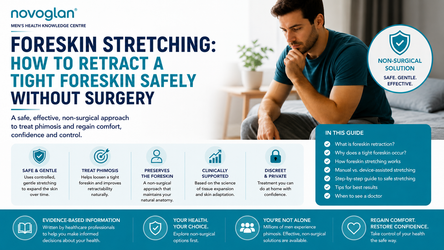
Foreskin Stretching: How to Retract a Tight Foreskin Safely Without Surgery
Posted by Kinza Khan, PharmD
14th Jul 2026
If your foreskin does not retract comfortably, you are not alone. Many men experience difficulty pulling the foreskin back over the head of the penis, particularly during adolescence or adulthood. While this condition can be worrying, a tight foreskin known medically as phimosis is often treatable without surgery.
For many men, gentle foreskin stretching is recommended as a first-line treatment. By applying controlled, gradual tension over time, stretching encourages the skin to expand naturally, allowing the foreskin to become more flexible and retract more comfortably.
In this guide, we'll explain how foreskin retraction works, why some men develop a tight foreskin, how phimosis stretching works, the role of balloon-based stretching devices such as Novoglan, and when you should seek medical advice.
Quick Answers About Foreskin Retraction
What is foreskin retraction?
Foreskin retraction is the ability to gently pull the foreskin back over the head of the penis (glans). In healthy adults, the foreskin should usually retract comfortably when the penis is flaccid and, in most cases, when erect. If the foreskin cannot be retracted because the opening is too tight, the condition is known as phimosis.
Can a tight foreskin be stretched?
In many cases, yes. Gentle foreskin stretching is widely recommended as a first-line, non-surgical treatment for mild to moderate phimosis. By applying gentle, consistent tension over time, stretching encourages the skin to gradually expand through a natural process called tissue expansion, making foreskin retraction easier and more comfortable.
Do I need circumcision?
Not always. Many men with phimosis can achieve comfortable foreskin retraction without surgery. Depending on the underlying cause and severity, treatment may include manual stretching exercises, prescription steroid creams, or medical devices designed to apply controlled, even stretching. Circumcision is generally considered when conservative treatments have been unsuccessful or when significant scarring is present.
How long does foreskin stretching take?
The time required varies depending on the severity of the tightness and how consistently treatment is followed. Some men notice improvement within 2 to 4 weeks, but achieving comfortable, full foreskin retraction often takes 6 to 12 weeks or longer. More severe cases may require several months of gradual stretching.
Can the Novoglan device help?
The Novoglan medical device is designed to support gentle, non-surgical foreskin stretching using an inflatable balloon that applies controlled, 360-degree pressure to the tight foreskin. This approach aims to encourage gradual tissue expansion and improve foreskin retraction while preserving the natural foreskin. Whether Novoglan is suitable for you depends on the underlying cause and severity of your condition, so it's important to follow the instructions for use and seek medical advice if you have significant scarring, severe pain, or ongoing symptoms.
Is Foreskin Retraction Normal?
Yes. In infancy and early childhood, the foreskin is naturally attached to the glans and is not expected to retract. As boys grow, the foreskin gradually separates from the glans as part of normal development. For many, this process occurs during childhood or adolescence, although the age at which full retraction becomes possible varies from person to person. In adults, however, the foreskin should generally retract without pain or excessive resistance.
Does foreskin stretching really work?
For many men with mild to moderate phimosis, gentle and consistent foreskin stretching can improve flexibility and make foreskin retraction easier over time. Results vary depending on the severity of the tightness, the underlying cause, and how consistently stretching is performed.
Is balloon stretching better than manual stretching?
Both techniques aim to achieve the same outcome. Manual stretching requires consistent technique, while balloon stretching devices are designed to apply gentle, even pressure around the tight foreskin. The most suitable option depends on your individual circumstances and preferences.
Is the Novoglan balloon painful?
When used according to the Instructions for Use, the Novoglan balloon is designed to provide gentle, controlled stretching. Stretching should not cause significant pain. If you experience severe discomfort, bleeding or persistent pain, stop treatment and seek medical advice.
Can I retract my foreskin when it is erect?
In healthy adults, the foreskin should usually retract comfortably when the penis is flaccid and, for many men, when erect. If retraction is painful or impossible, it may indicate phimosis or another underlying condition that should be assessed.
Can stretching damage my foreskin?
Gentle stretching should not damage healthy skin. However, forcing the foreskin back or stretching too aggressively can cause small tears, bleeding and scarring, which may worsen phimosis. Stretching should always be gradual and stopped if significant pain occurs.
Why Is Foreskin Retraction Important?
Being able to retract the foreskin plays an important role in maintaining penile health. Gentle retraction during washing helps remove sweat, urine, dead skin cells and smegma, reducing the build-up of moisture that can contribute to irritation, unpleasant odour and infections such as balanitis.
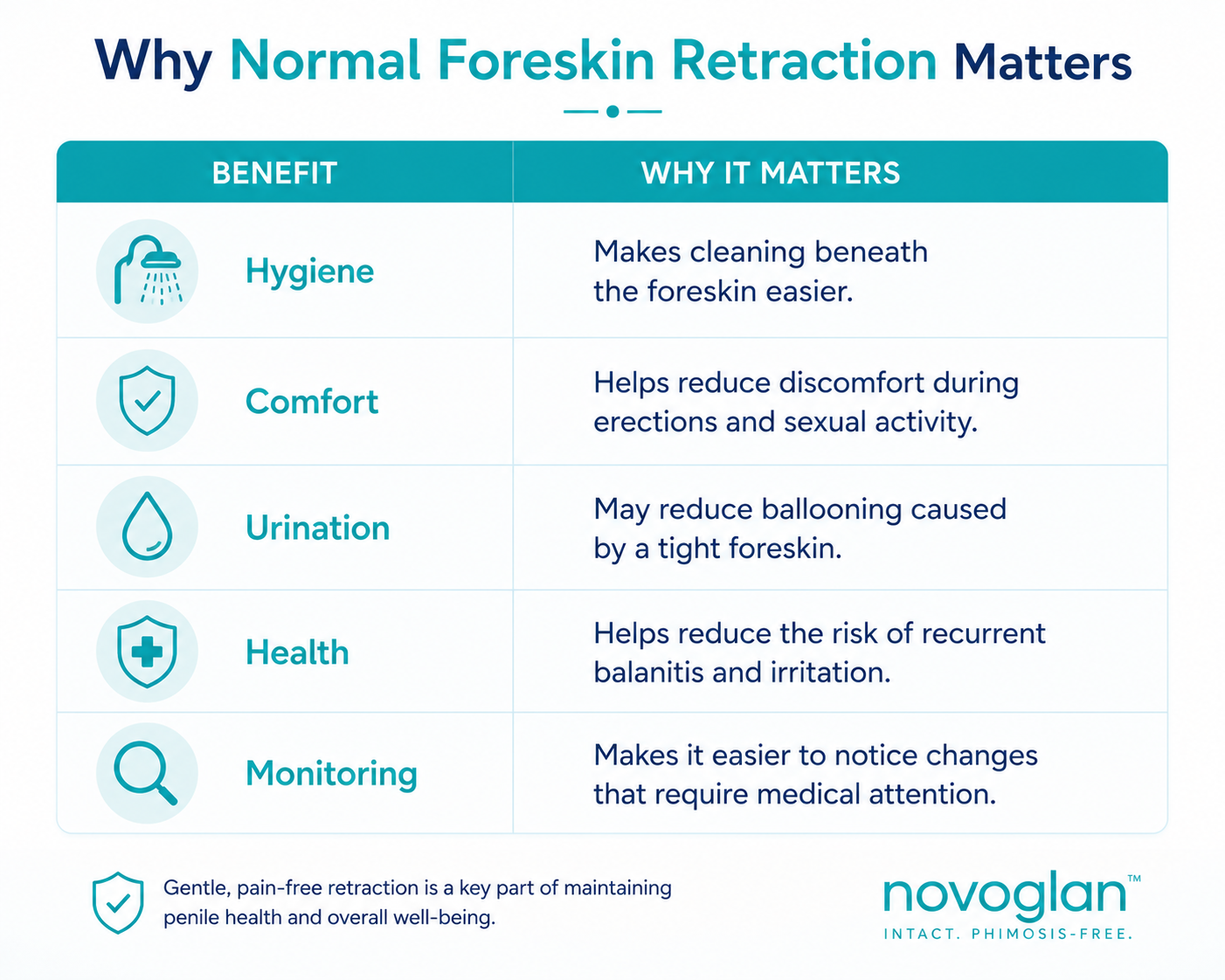
Normal foreskin retraction may also:
- Support good genital hygiene
- Reduce the risk of recurrent balanitis and other infections
- Improve comfort during erections and sexual activity
- Make urination easier if a tight foreskin is causing obstruction
- Help identify changes to the skin that may require medical attention
It is important to remember that the foreskin should never be forced back. Attempting to force a tight foreskin can cause small tears, bleeding and scarring, which may worsen the tightness over time.
When Is Difficulty Retracting the Foreskin a Problem?
If you are an adult and your foreskin won't retract comfortably, feels tight, causes pain, or repeatedly becomes inflamed, it may indicate phimosis or another underlying condition.
Fortunately, many cases of mild to moderate phimosis can be managed with conservative treatments such as gentle foreskin stretching, topical medications prescribed by a healthcare professional, or medical devices designed to apply controlled, even pressure to encourage gradual tissue expansion.
The following sections explain why a tight foreskin develops, how stretching works, and what treatment options are available.
Why Stretching has become a popular conservative treatment
Before purpose-designed stretching devices became available, men with phimosis often had limited treatment options beyond manual stretching or surgery. Today, conservative approaches, including gentle manual stretching and balloon-assisted stretching, provide suitable men with a non-surgical option that can often be performed at home under the guidance of a healthcare professional.
Modern stretching devices are designed to apply gentle, even pressure to the tight portion of the foreskin, helping support gradual tissue expansion while reducing the need to force the foreskin back. When used consistently and according to the manufacturer's instructions, these devices may provide a structured approach to conservative foreskin stretching.
Why might my foreskin not retract?
If your foreskin won't retract, you are not alone. Difficulty pulling the foreskin back over the head of the penis is a common concern and is often caused by phimosis, where the opening of the foreskin is too tight to move comfortably over the glans.
While the situation can be frustrating or concerning, it doesn't always mean there's a serious problem. In many cases, conservative treatment can help manage a tight foreskin once the underlying cause has been identified.
Common Reasons Your Foreskin Won't Retract
There are several possible reasons why your foreskin may feel tight or difficult to retract.
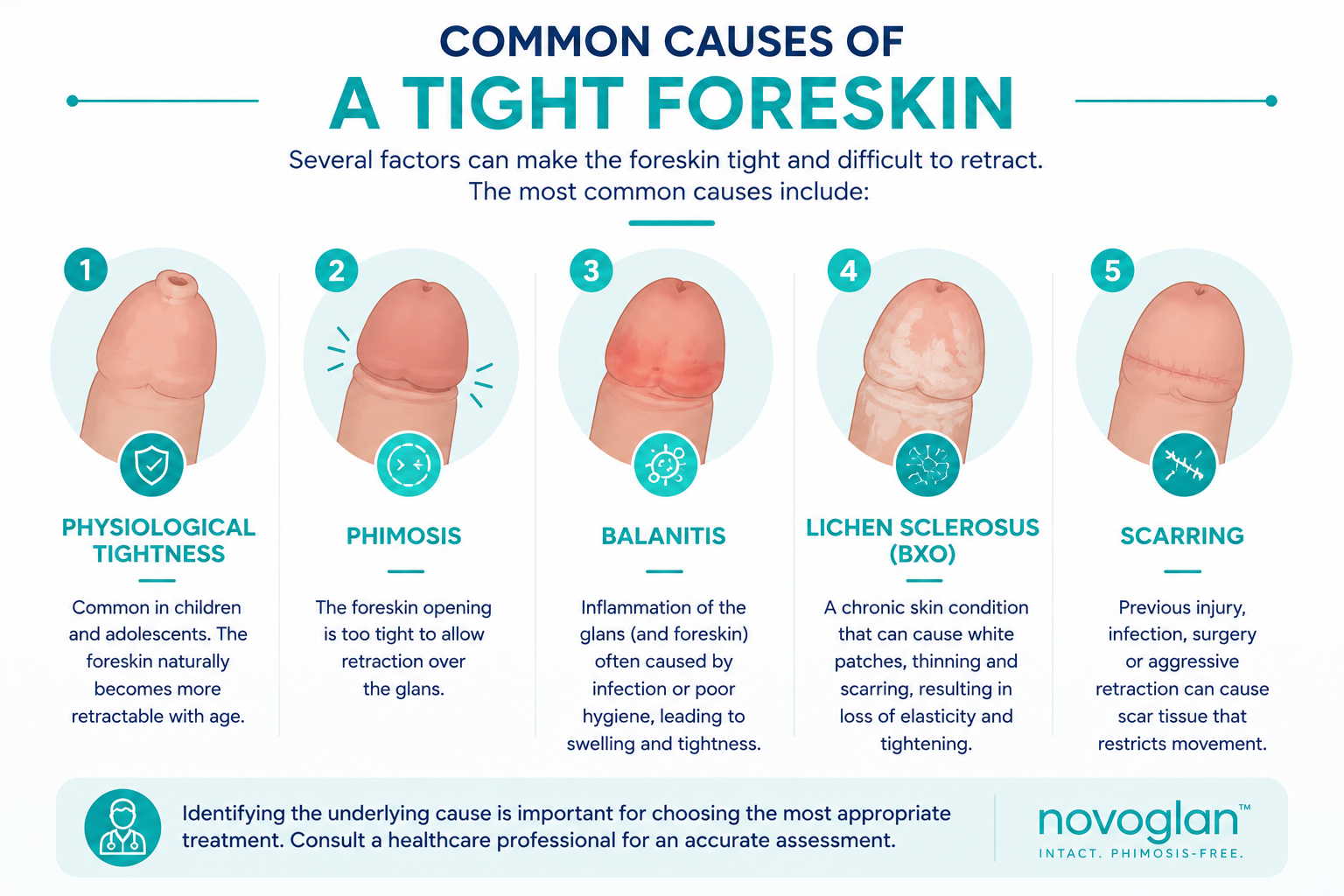
Physiological Tight Foreskin
In babies and young boys, the foreskin is naturally attached to the glans and usually cannot be retracted. As the body develops, the foreskin gradually separates and becomes more flexible. For some individuals, this process continues into the teenage years.
If you're an adult and your foreskin still won't retract comfortably, it is worth discussing the issue with a healthcare professional.
Phimosis
Phimosis is the most common reason an adult foreskin won't retract. It occurs when the opening of the foreskin is too narrow to pass comfortably over the glans.
Depending on its severity, phimosis may cause the following:
- Recurrent infections such as balanitis
- Difficulty cleaning beneath the foreskin
- Pain during erections or sexual activity
- Ballooning of the foreskin during urination
Many cases of mild to moderate phimosis can be treated without surgery using gentle stretching techniques or other conservative management options.
Scarring
Previous inflammation, repeated infections, or skin conditions such as lichen sclerosus (BXO) can cause scar tissue to form around the foreskin opening.
Unlike normal tight skin, scar tissue is less elastic and may not respond to stretching in the same way. If you notice a tight white ring around the foreskin or experience repeated tearing, you should seek medical assessment before attempting stretching exercises.
Inflammation or Infection
Conditions such as balanitis can temporarily make the foreskin swollen, sore and difficult to retract.
In many cases, the tightness improves once the inflammation has been treated. However, repeated episodes of balanitis may eventually lead to scarring that contributes to phimosis.
Should You Force the Foreskin Back?
No. A tight foreskin should never be forced.
Pulling the foreskin back with excessive force can cause small tears in the skin. As these tears heal, scar tissue may develop, making the foreskin even tighter over time and increasing the risk of complications such as paraphimosis, where the foreskin becomes trapped behind the glans.
Instead, treatment should focus on gradually improving foreskin flexibility using gentle, controlled stretching or other treatments recommended by your healthcare professional.
The Good News
For many men, difficulty retracting the foreskin does not automatically mean surgery is necessary. If the tightness is caused by uncomplicated phimosis rather than significant scarring, conservative treatment approaches such as gentle foreskin stretching, prescription medications where appropriate, or medical devices designed to provide controlled tissue expansion can often help improve foreskin retraction over time.
The next section explains how foreskin stretching works and why gradual, consistent stretching is considered a first-line treatment for many men with mild to moderate phimosis.
Normal Foreskin Retraction by Age
One of the most common questions men and parents ask is, "At what age should the foreskin retract?" The answer is that there is no single age at which the retraction happens.
In newborns and young boys, the foreskin is naturally attached to the glans (head of the penis) and usually cannot be retracted. This is a normal part of development and helps protect the sensitive glans during early childhood.
As a child grows, the foreskin gradually separates from the glans and becomes more flexible. For some boys, this process occurs during early childhood, while for others it continues throughout puberty. Both can be completely normal.
By adulthood, however, the foreskin should generally retract comfortably without pain or significant resistance. If an adult is unable to fully retract the foreskin, or if retraction causes pain, bleeding, or repeated infections, this may indicate phimosis or another underlying condition that should be assessed by a healthcare professional.
Typical Foreskin Development
|
Age |
What Is Usually Normal? |
|
Birth to early childhood |
The foreskin is usually attached to the glans and should not be forcibly retracted. |
|
Childhood |
The foreskin gradually becomes more mobile as natural separation occurs. Some boys can retract it, while others cannot yet. |
|
Adolescence (Puberty) |
Most boys develop increasing foreskin mobility as the penis grows and the foreskin becomes more flexible. |
|
Adulthood |
The foreskin should usually retract comfortably when flaccid and, for many men, when erect. Persistent tightness, pain or inability to retract may require medical assessment. |
When Should You Seek Medical Advice?
You should speak with a healthcare professional if:
- Your foreskin cannot be retracted by adulthood.
- Retraction is painful or causes bleeding.
- You experience recurrent infections such as balanitis.
- The foreskin becomes trapped behind the glans (paraphimosis).
- You notice scarring, a tight white ring, or persistent swelling.
Remember, never force the foreskin back. Forced retraction can cause tears, scarring and long-term tightening, making the problem worse.
Phimosis Stretching: Does It Really Work?
Gentle foreskin stretching is one of the most widely used conservative treatments for uncomplicated phimosis. The principle behind stretching is simple: when light, controlled tension is applied consistently over time, the skin gradually adapts through a natural process known as tissue expansion. Rather than forcing the foreskin back, stretching aims to improve its flexibility gradually, making retraction more comfortable. Many healthcare professionals recommend conservative stretching before considering surgery for suitable men with mild to moderate phimosis.
How Does Foreskin Stretching Work?
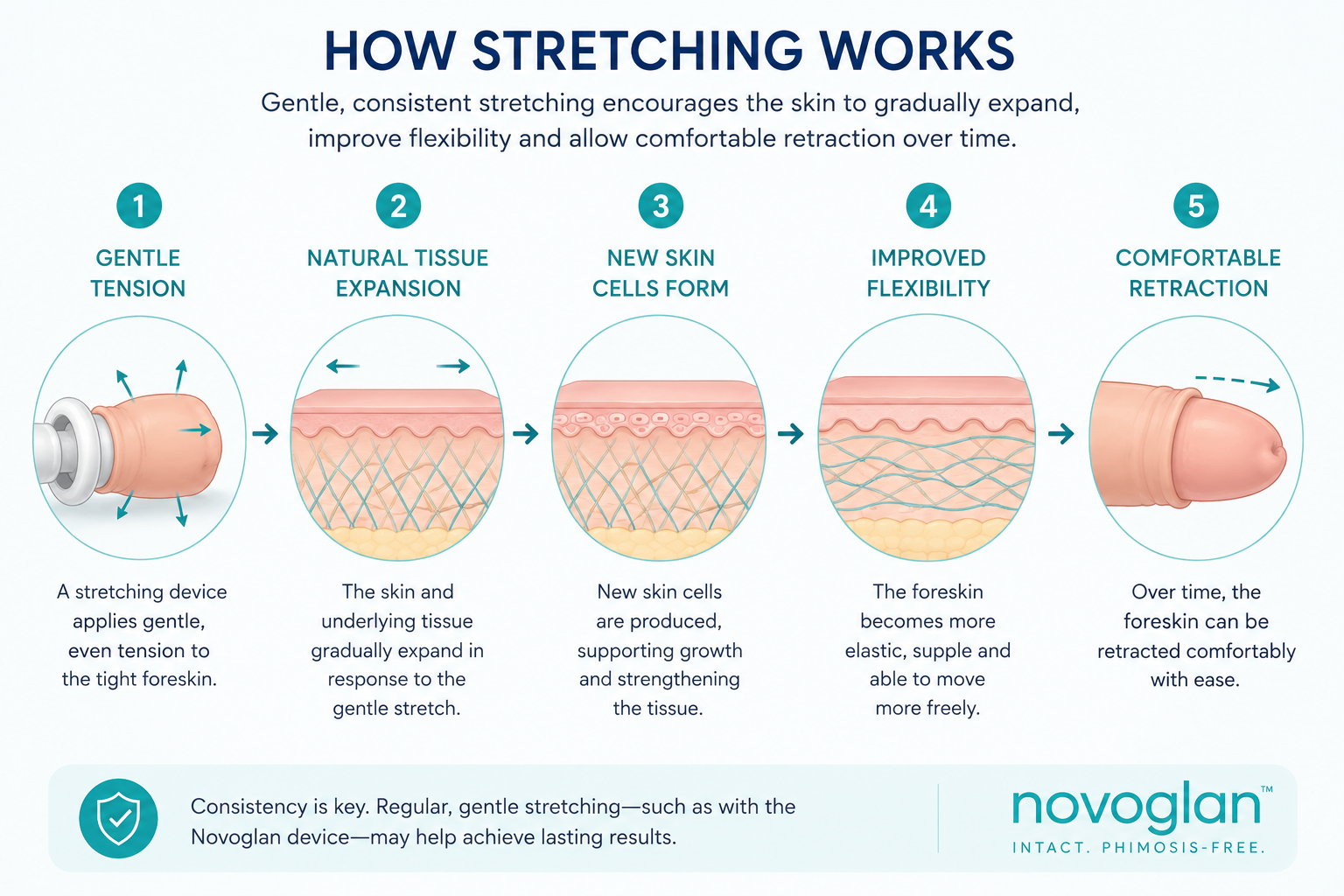
Gentle foreskin stretching is a widely used conservative treatment for men with tight foreskins. The key to successful stretching is consistency rather than force. Gentle, regular stretching encourages the foreskin to adapt naturally, helping to improve comfort and make foreskin retraction easier over time.
Stretching can be performed manually using the fingers or with medical devices like Novoglan specifically designed to provide controlled, even pressure around the tight foreskin.
The Science Behind Skin Expansion
Foreskin stretching works because skin is a living tissue that can gradually adapt to gentle, sustained tension. When a small amount of consistent stretch is applied over time, the body responds by producing new skin cells through a natural biological process known as tissue expansion.
This gradual process allows the foreskin to become more flexible without damaging the tissue when stretching is performed correctly. Because skin growth takes time, improvements are usually seen over weeks rather than days, and results depend on factors such as the severity of the tightness and how consistently treatment is followed.
Medical devices such as the Novoglan balloon are designed to apply gentle, even pressure around the tight portion of the foreskin, supporting controlled tissue expansion while helping to avoid the uneven force that can occur with aggressive stretching.
Manual Foreskin Stretching
Manual foreskin stretching involves gently applying tension to the tight portion of the foreskin using your fingers. The aim is not to force the foreskin back, but to apply light, consistent stretching over time so the skin can gradually become more flexible.
Many healthcare professionals recommend manual stretching as a first-line treatment for mild to moderate phimosis because it is non-invasive, inexpensive and can often be performed at home.
The most important principles are the following:
- Stretch gently without causing pain.
- Avoid forcing the foreskin behind the glans.
- Be consistent, as improvements usually occur gradually over several weeks.
If stretching causes significant pain, bleeding or tearing, stop and seek advice from a healthcare professional.
Foreskin Balloon Stretching
An alternative to manual stretching is foreskin balloon stretching, which uses a specially designed medical device to apply gentle, even pressure around the tight foreskin.
Unlike manual stretching, where the amount and direction of force can vary, a balloon device expands evenly to stretch the tight ring of tissue in a controlled manner. This may provide a more consistent approach for some men, particularly if manual stretching is difficult or uncomfortable.
As with any stretching technique, results depend on regular use, following the manufacturer's instructions, and allowing the skin time to adapt naturally.
How the Novoglan Balloon Works
The Novoglan Treatment Kit uses a patented inflatable balloon that is positioned between the glans and the inside of the foreskin. Once inflated, the balloon applies gentle, 360-degree pressure to the tight portion of the foreskin.
This controlled stretching is designed to encourage the skin's natural tissue expansion process, helping the foreskin gradually become more flexible and easier to retract over time.
Because the pressure is applied evenly around the circumference of the foreskin, the balloon aims to provide a more consistent stretch that may not be achieved with manual stretching alone. The device is intended for home use and should always be used according to the Instructions for Use.
While many men may benefit from conservative stretching, individual results vary depending on the severity of the tightness, consistency of treatment, and the underlying cause of the condition. If you experience severe pain, significant scarring, or recurrent infections, seek assessment from a healthcare professional before beginning treatment. Always read the full Novoglan treatment instructions and IFU before you begin the treatment.
Benefits of Balloon Stretching vs Manual Stretching
Both manual foreskin stretching and balloon stretching aim to achieve the same goal: gradually increasing the flexibility of the tight foreskin to improve retraction. The best approach depends on the individual's needs, the severity of the tightness, and personal preference.
Manual stretching is simple and doesn't require any equipment, making it a suitable option for many men with mild phimosis. However, because the user controls the amount and direction of pressure, the stretch may not always be even or consistent.
Balloon stretching devices, such as the Novoglan Treatment Kit, are designed to apply gentle, even pressure around the circumference of the tight foreskin. This controlled approach may help provide a more consistent stretch and can be easier for some men to perform at home.
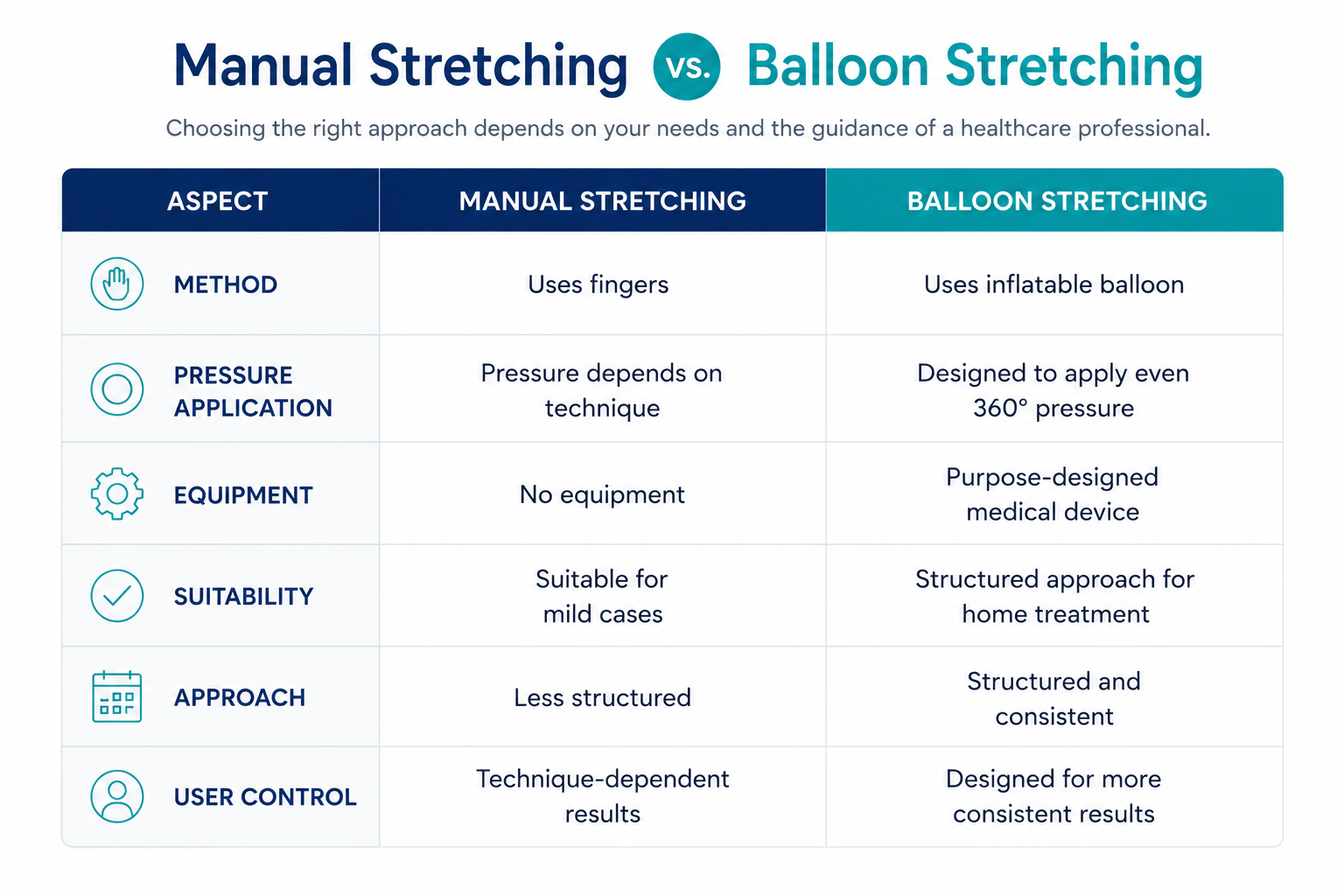
Whichever method you use, gentle, consistent stretching is the key to success, not force.
Mistakes That Can Make Tight Foreskin Worse
When performed correctly, gentle stretching is generally well tolerated. However, certain mistakes can increase the risk of pain, scarring or further tightening of the foreskin.
Common mistakes include:
- Ignoring pain, swelling or signs of infection.
- Forcing the foreskin back, which can cause tears and bleeding.
- Stretching too aggressively instead of applying gentle, gradual tension.
- Being inconsistent with treatment makes it harder for the skin to adapt.
- Continuing to stretch during active balanitis or another untreated infection, which may worsen inflammation.
- Using unapproved methods or devices can damage the delicate foreskin tissue.
Remember, the goal of foreskin stretching is to encourage the skin to adapt gradually, not to force immediate retraction. If you are unsure whether stretching is appropriate for your situation, seek advice from a healthcare professional before starting treatment.
When Is Foreskin Stretching Not Appropriate?
While gentle foreskin stretching can be an effective conservative treatment for many men with mild to moderate phimosis, it isn't suitable for everyone.
You should seek medical advice before attempting stretching if you have:
- Severe pain or bleeding
- A tight white scar ring that may suggest significant scarring or lichen sclerosus (BXO)
- Active balanitis or another untreated infection
- Paraphimosis (where the foreskin becomes trapped behind the glans)
- Persistent ulcers, sores or unusual skin changes
- A history of recurrent tearing or significant scarring
Stretching should never be painful or forceful. If you're unsure of the underlying cause of your tight foreskin, an assessment by a healthcare professional can help determine the most appropriate treatment.
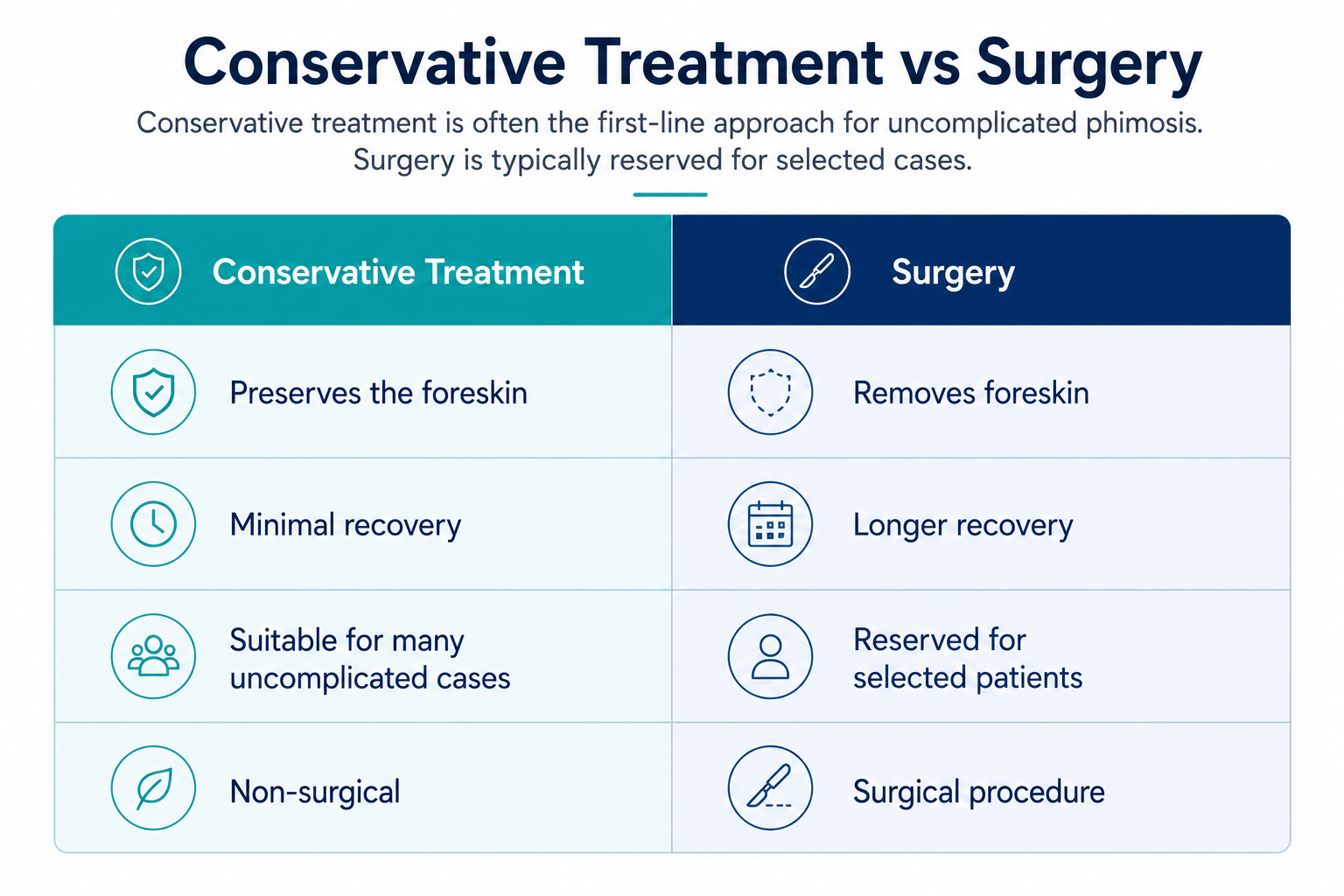
Conclusion
Difficulty retracting the foreskin is a common concern, and for many men it is caused by phimosis, a condition that can often be managed without surgery. The first step in picking the best treatment is to figure out why the foreskin is tight.
Gentle, consistent foreskin stretching is widely used as a conservative approach to improving foreskin flexibility and retraction. Whether performed manually or with a purpose-designed medical device such as the Novoglan Treatment Kit, successful stretching relies on patience, consistency and following the correct technique.
If your symptoms persist, worsen, or are associated with significant pain, recurrent infections or scarring, seek advice from a healthcare professional. Early assessment can help identify the underlying cause and ensure you receive the treatment that's most appropriate for your individual needs.
References & Clinical Sources
- European Association of Urology. EAU Guidelines on Penile Disorders & Paediatric Urology Guidelines. Available online at: uroweb.org
- National Health Service (NHS). Phimosis and Paraphimosis Overview & Management. NHS Health A-Z.
- McPhee, S. J., & Papadakis, M. A. Current Medical Diagnosis & Treatment. McGraw-Hill Medical.
- Hayashi, Y., et al. Prevalence and natural history of phimosis in schoolboys and conservative management options. International Journal of Urology.
- Drake, T., et al. Tissue Expansion Principles in Non-Surgical Phimosis Management. Journal of Pediatric & Adult Urology.